

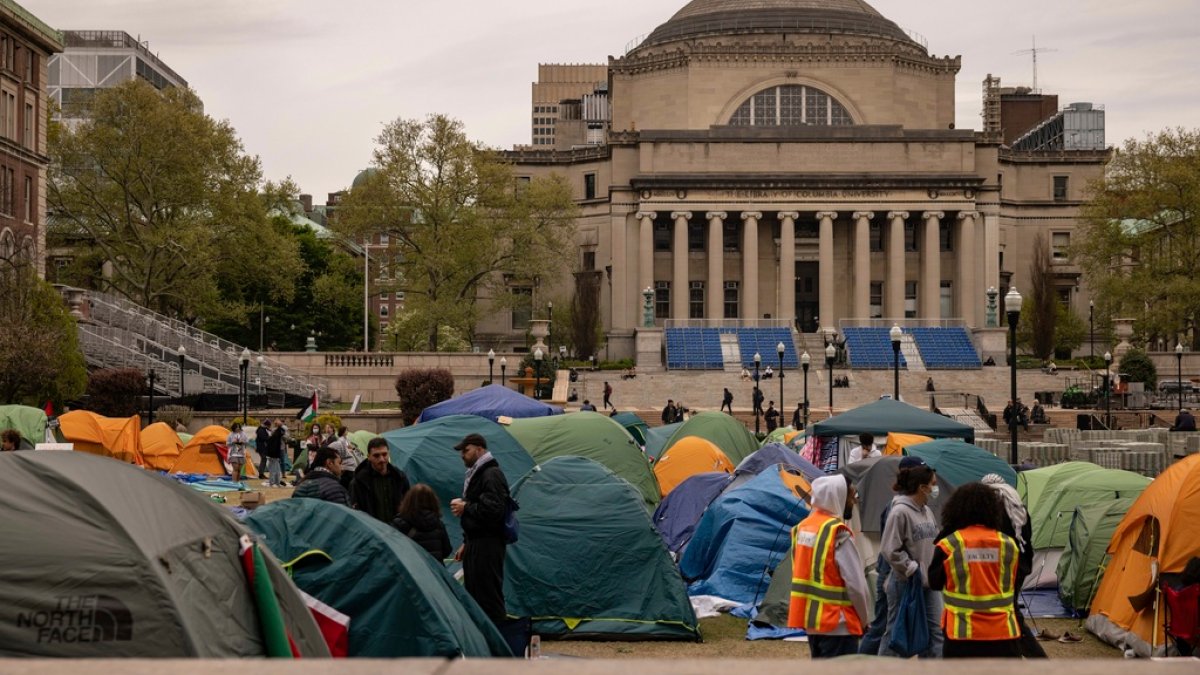
From
New
York
to
California,
students
protesting
the
Israel-Hamas
war
slept
in
tents at
college
campuses,
as
some
universities
moved
to
shut
down
encampments
and
arrested
dozens
of
demonstrators.
With
the
death
toll
mounting
in the
war
in
Gaza,
protesters
nationwide
are
demanding schools
cut
financial
ties to
Israel
and
divest
from
companies
they
say
enable
the
conflict.
Some
Jewish
students
say
the
protests
have
veered
into
antisemitism
and
made
them
afraid
to
set
foot
on
campus.
At
Columbia
University
in
New
York
City,
where
early
protests
sparked pro-Palestinian
demonstrations across
the
country,
students
and
administrators
have
engaged
in
negotiations,
the
university
said
in
a
statement
Saturday
night.
“Dialogue
between
university
officials
and
student
organizers
is
ongoing.
We
want
to
be
clear:
There
is
no
truth
to
claims
of
an
impending
lockdown
or
evictions
on
campus,”
the
Columbia
administration’s
statement
said.
Though
the
university
repeatedly
set
and
then
pushed
back
deadlines
for
the
removal
of
the
encampment,
the
school
sent
an
email
to
students
saying
that
bringing
back
police
“at
this
time”
would
be
counterproductive.
Pro-Palestinian
student
groups
did
not
speak
to
reporters
on
Saturday,
but
did
post
on
social
media
claiming
that
Columbia
administration
considered
a
complete
lockdown
and
evictions
in
response
to
ongoing
student
action.
With
the
final
day
of
classes
looming
and
the
countdown
to
graduation
ticking
down,
seniors
shared
mixed
feelings
about
how
all
of
this
could
impact
commencement.
“Knowing
that
there
is
such
an
issue
that’s
happening
across
the
country,
not
even
Columbia
anymore,
I’m
very
much
willing
to
sacrifice
a
graduation,”
said
Columbia
senior
Matthew.
“I
don’t
want
it
to
be
canceled
or
to
have
a
protest
happening
in
the
middle,”
another
senior,
Marc
Blattner,
said.
“I
just
want
to
get
my
degree
and
go
home.”
The
nationwide
campus
protests
began
in
response
to
Israel’s
offensive
in
Gaza.
Hamas
launched
a
deadly
attack
on
southern
Israel
on
Oct.
7,
when
militants
killed
about
1,200
people,
most
of
them
civilians,
and
took
roughly
250
hostages.
Vowing
to
stamp
out
Hamas,
Israel
launched
an
offensive
in
Gaza.
In
the
ensuing
war,
Israel
has
killed
more
than
34,000
Palestinians
in
the
Gaza
Strip,
according
to
the
local
health
ministry.
Israel
and
its
supporters
have
branded
the
university
protests
as
antisemitic,
while
critics
of
Israel
say
it
uses
such
allegations
to
silence
opponents.
Although
some
protesters
have
been
caught
on
camera
making
antisemitic
remarks
or
violent
threats,
organizers
of
the
protests,
some
of
whom
are
Jewish,
say
it
is
a
peaceful
movement
aimed
at
defending
Palestinian
rights
and
protesting
the
war.
Police
response
Decisions
to
call
in
law
enforcement,
leading
to
hundreds
of
arrests
nationwide,
have
prompted
school
faculty
members
at
universities
in
California,
Georgia
and
Texas
to
initiate
or
pass
votes
of
no
confidence
in
their
leadership.
They
are
largely
symbolic
rebukes,
without
the
power
to
remove
their
presidents.
Washington
University
in
St.
Louis
locked
some
campus
buildings
and
arrested
protesters
Saturday.
The
St.
Louis
Police
Department
said
in
a
social
media
post
that
it
assisted
campus
police,
although
city
officers
did
not
make
any
arrests.
The
Riverfront
Times,
a
St.
Louis
weekly
newspaper,
reported
more
than
80
people
were
arrested
during
the
protest
that
began
in
public
areas
before
moving
to
the
campus
in
the
afternoon.
Megan
Green,
president
of
the
St.
Louis
Board
of
Aldermen,
said
in
a
social
media
post
that
she
was
present
and
the
protest
remained
calm
“until
the
police
came
in
like
an
ambush.”
Green
Party
Presidential
Candidate
Jill
Stein
said
in
a
social
media
post
that
she
and
two
of
her
campaign
managers
were
among
those
arrested
on
the
Washington
University
campus.
The
University
of
Southern
California
said
on
Saturday
it
had
temporarily
closed
its
University
Park
Campus
to
nonresidents,
without
providing
details
of
the
closure
or
possible
enforcement
measures.
Joel
Curran,
senior
vice
president
of
communications,
said
in
a
statement
that
USC
property
was
vandalized
by
members
of
a
group
“that
has
continued
to
illegally
camp
on
our
campus,”
as
well
as
disrupting
operations
and
harrassing
students
and
others.
Students
declined
numerous
attempts
by
university
President
Carol
Folt
to
meet,
and
the
administration
hopes
for
“a
more
reasonable
response
Sunday
before
we
are
forced
to
take
further
action,”
Curran
said.
“While
the
university
fully
supports
freedom
of
expression,
these
acts
of
vandalism
and
harassment
are
absolutely
unacceptable
and
will
not
be
tolerated,”
Curran
said.
In
Boston,
police
in
riot
gear
cleared
an
encampment
on
the
campus
of
Northeastern
University
on
Saturday.
Massachusetts
State
Police
said
about
102
protesters
were
arrested
and
will
be
charged
with
trespassing
and
disorderly
conduct.
Protesters
said
they
were
given
about
15
minutes
to
disperse
before
being
arrested.
As
workers
pulled
down
tents
and
bagged
up
the
debris
from
the
encampment,
several
dozen
people
across
from
the
encampment
chanted,
“Let
the
Kids
Go,”
and
slogans
against
the
war
in
Gaza.
They
also
booed
as
police
cars
passed
and
taunted
the
officers
who
stood
guard.
Northeastern
said
in
a
statement
that
the
demonstration,
which
began
two
days
ago,
had
become
“infiltrated
by
professional
organizers”
with
no
affiliation
to
the
university
and
antisemitic
slurs,
including
“kill
the
Jews,”
had
been
used.
“We
cannot
tolerate
this
kind
of
hate
on
our
campus,”
the
statement
posted
on
social
media
said.
The
Huskies
for
a
Free
Palestine
student
group
disputed
the
university’s
account,
saying
in
a
statement
that
counterprotesters
were
to
blame
for
the
slurs
and
no
student
protesters
“repeated
the
disgusting
hate
speech.”
Students
at
the
Boston
protest
said
a
counterprotester
attempted
to
instigate
hate
speech
but
insisted
their
event
was
peaceful
and,
like
many
across
the
country,
was
aimed
at
drawing
attention
to
what
they
described
as
the
“genocide”
in
Gaza
and
their
university’s
complicity
in
the
war.
The
president
of
nearby
Massachusetts
Institute
of
Technology
said
in
a
statement
Saturday
that
an
encampment
there
had
become
a
“potential
magnet
for
disruptive
outside
protesters”
and
was
taking
hundreds
of
staff
hours
to
keep
safe.
“We
have
a
responsibility
to
the
entire
MIT
community
—
and
it
is
not
possible
to
safely
sustain
this
level
of
effort,”
MIT
President
Sally
Kornbluth
said.
“We
are
open
to
further
discussion
about
the
means
of
ending
the
encampment.
But
this
particular
form
of
expression
needs
to
end
soon.”
Indiana
University
campus
officers
and
state
police
arrested
23
people
Saturday
at
an
encampment
on
the
school’s
Bloomington
campus.
Tents
and
canopies
were
erected
Friday
at
Dunn
Meadow
in
violation
of
school
policy,
university
police
said
in
a
release.
Group
members
were
detained
after
refusing
to
remove
the
structures
with
charges
ranging
from
criminal
trespass
to
resisting
law
enforcement,
police
said.
Arizona
State
University
said
69
people
were
arrested
early
Saturday
on
suspicion
of
criminal
trespassing
for
setting
up
an
unauthorized
encampment
on
a
lawn
on
its
Tempe
campus.
The
protesters
were
given
chances
to
leave
and
those
who
refused
were
arrested.
“While
the
university
will
continue
to
be
an
environment
that
embraces
freedom
of
speech,
ASU’s
first
priority
is
to
create
a
safe
and
secure
environment
that
supports
teaching
and
learning,”
the
university
said
in
a
statement.
The
tensions
have
piled
pressure
on
school
officials,
who
are
scrambling
to
resolve
the
protests
as
May graduation
ceremonies near.
USC
drew
criticism
after
refusing
to
allow
the
valedictorian,
who
has
publicly
supported
Palestinians,
to
make
a
commencement
speech.
Administrators
then
scrapped
the
keynote
speech
by
filmmaker
Jon
M.
Chu.
The
school
on
Thursday
announced
the cancellation
of
its
main
graduation
event,
a
day
after
more
than
90
protesters
were
arrested
by
police
in
riot
gear.
Folt,
the
university
president,
made
her
first
public
statement
late
Friday,
addressing
the
controversies
as
“incredibly
difficult
for
all
of
us.”
“No
one
wants
to
have
people
arrested
on
their
campus.
Ever.
But,
when
long-standing
safety
policies
are
flagrantly
violated,
buildings
vandalized,
Department
of
Public
Safety
directives
repeatedly
ignored,
threatening
language
shouted,
people
assaulted,
and
access
to
critical
academic
buildings
blocked,
we
must
act
immediately
to
protect
our
community,”
Folt
said.