
What
to
Know
-
Cars
will
be
charged
an
additional
$15
to
enter
Manhattan
at
61st
Street
and
below,
while
trucks
could
be
charged
between
$24
and
$36,
depending
on
size -
There
are
some
planned
exemptions.
Most
of
those
will
likely
include
government
vehicles.
Yellow
school
buses
with
a
contract
with
the
DOE
are
also
in
the
clear,
as
are
city-owned
vehicles -
The
MTA
board
overwhelmingly
voted
to
approve
congestion
pricing
in
December,
saying
charging
drivers
to
enter
a
swath
of
Manhattan
would
contribute
millions
of
dollars
to
the
aging
transit
system
June
30.
That’s
when
car
drivers
will
be
charged
an
additional
$15
to
enter
Manhattan
at
61st
Street
and
below,
while
trucks
could
be
charged
between
$24
and
$36,
depending
on
size.
The
long-awaited
congestion
pricing
model
set
to
make
history
in
the
United
States
will
begin
in
New
York
City
at
12:01
a.m.
on
the
final
Sunday
in
June,
MTA
officials
announced.
The
date
is
two
weeks
later
than
the
transit
agency
had
initially
targeted.
Most
of
the
cars
likely
to
get
full
exemptions
will
be
government
vehicles. Get
details
on
the
planned
exemption
list
here —
like
school
buses,
commuter
buses
and
essential
government
vehicles
owned
by
the
city.
Not
exempt?
New
Jersey
drivers,
though
lawsuits
could
change
theoretically
change
that.
Though
the
MTA
did
not
seem
terribly
concerned
about
that
prospect.
The
toll
will
not
be
in
effect
for
taxis,
but
drivers
will
be
charged
a
$1.25
surcharge
per
ride.
The
same
policy
applies
to
Uber,
Lyft
and
other
rideshare
drivers,
though
their
surcharge
will
be
$2.50.
In
late
March,
all
but
one
MTA
board
member
green-lit
a
plan
that
will,
in
less
than
two
months,
start
charging
cars
$15
to
enter
Manhattan
below
61st
Street.
Trucks
will
see
higher
tolls.
All
110
toll
readers
are
installed,
positioning
the
MTA
to
be
ready
to
collect
by
June.
Federal
judges
on
either
side
of
the
river
could
delay
the
plans,
but
the
MTA
has
said
it
expects
those
legal
challenges
to
fail.
Congestion
pricing
itself
was
approved
in
December.
The
MTA
board
voted
overwhelmingly
in
favor,
saying
charging
drivers
to
enter
a
swath
of
Manhattan
would
contribute
millions
of
dollars
to
the
aging,
cash-strapped
transit
system.
The
MTA
has
said
the
plan
will
deliver
$15
billion
that
will
help
pay
for
new
trains
and
signals,
as
well
as
other
fixes.

News
4’s
Andrew
Siff
reports.
How
does
congestion
pricing
work?
Congestion
pricing
will
impact
any
driver
entering
what
is
being
called
the
Central
Business
District
(CBD),
which
stretches
from
60th
Street
in
Manhattan
and
below,
all
the
way
down
to
the
southern
tip
of
the
Financial
District.
In
other
words,
most
drivers
entering
midtown
Manhattan
or
below
will
have
to
pay
the
toll,
according
to
the
board’s
report.
All
drivers
of
cars,
trucks,
motorcycles
and
other
vehicles
would
be
charged
the
toll.
Different
vehicles
will
be
charged
different
amounts
—
here’s
a
breakdown
of
the
prices:
-
Passenger
vehicles:
$15 -
Small
trucks
(like
box
trucks,
moving
vans,
etc.):
$24 -
Large
trucks:
$36 -
Motorcycles:
$7.50
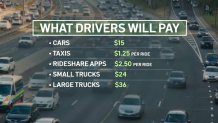
The
$15
toll
is
about
a
midway
point
between
previously
reported
possibilities,
which
have
ranged
from
$9
to
$23.
The
full,
daytime
rates
will
be
in
effect
from
5
a.m.
until
9
p.m.
each
weekday,
and
9
a.m.
until
9
p.m.
on
the
weekends.
The
board
called
for
toll
rates
in
the
off-hours
(from
9
p.m.-5
a.m.
on
weekdays,
and
9
p.m.
until
9
a.m.
on
weekends)
to
be
about
75%
less
—
about
$3.50
instead
of
$15
for
a
passenger
vehicle.
Drivers
will
only
be
charged
to
enter
the
zone,
not
to
leave
it
or
stay
in
it.
That
means
residents
who
enter
the
CBD
and
circle
their
block
to
look
for
parking
won’t
be
charged.
Only
one
toll
will
be
levied
per
day
—
so
anyone
who
enters
the
area,
then
leaves
and
returns,
will
still
only
be
charged
the
toll
once
for
that
day.
The
review
board
said
that
implementing
their
congestion
pricing
plan
is
expected
to
reduce
the
number
of
vehicles
entering
the
area
by
17%.
That
would
equate
to
153,000
fewer
cars
in
that
large
portion
of
Manhattan.
They
also
predicted
that
the
plan
would
generate
$15
billion,
a
cash
influx
that
could
be
used
to
modernize
subways
and
buses.
An
MTA
fare
increase
is
likely
to
come
sooner
than
expected
to
public
transportation.
Tracie
Strahan
reports.
Can
I
get
a
discount?
Many
groups
had
been
hoping
to
get
exemptions,
but
very
few
will
avoid
having
to
pay
the
toll
entirely.
That
small
group
is
limited
to
specialized
government
vehicles
(like
snowplows)
and
emergency
vehicles.
Low-income
drivers
who
earn
less
than
$50,000
a
year
can
apply
to
pay
half
the
price
on
the
daytime
toll,
but
only
after
the
first
10
trips
in
a
month.
While
not
an
exemption,
there
will
also
be
so-called
“crossing
credits”
for
drivers
using
any
of
the
four
tunnels
to
get
into
Manhattan.
That
means
those
who
already
pay
at
the
Lincoln
or
Holland
Tunnel,
for
example,
will
not
pay
the
full
congestion
fee.
The
credit
amounts
to
$5
per
ride
for
passenger
vehicles,
$2.50
for
motorcycles,
$12
for
small
trucks
and
$20
for
large
trucks.
Drivers
from
Long
Island
and
Queens
using
the
Queens-Midtown
Tunnel
will
get
the
same
break,
as
will
those
using
the
Brooklyn-Battery
Tunnel.
Those
who
come
over
the
George
Washington
Bridge
and
go
south
of
60th
Street
would
see
no
such
discount,
however.
Public-sector
employees
(teachers,
police,
firefighters,
transit
workers,
etc.),
those
who
live
in
the
so-called
CBD,
utility
companies,
those
with
medical
appointments
in
the
area
and
those
who
drive
electric
vehicles
had
all
been
hoping
to
get
be
granted
an
exemption.
They
didn’t
get
one.
UFT
President
Michael
Mulgrew,
one
of
the
lead
plaintiffs
in
a
federal
lawsuit
again
congestion
pricing,
said
following
the
MTA
approval
that
now
it’s
the
courts’
job
to
step
in.
“Now
that
the
MTA
board
has
voted,
it
is
going
to
be
up
to
the
courts
to
prevent
the
huge
environmental
injustice
that
threatens
families
outside
the
Manhattan
congestion
zone,
including
communities
that
are
already
suffering
some
of
the
worst
air
pollution
and
asthma
rates
in
the
country,”
Mulgrew
said.
New
Jersey
is
filing
a
lawsuit
aimed
at
the
Federal
Highway
Administration
regarding
the
upcoming
congestion
pricing
in
NYC.
Patricia
Battle
reporting.